How to Get Your Business Seen by AI – Getting to Grips with AI Visibility
15.12.25

15.12.25


More and more people are turning to artificial intelligence (AI) tools to help with research, information gathering, and outputs. From learning how to carry out everyday tasks, to complex challenges experienced in a professional environment, AI is at the heart of it. A core part of everyday AI use is AI chatbots, underpinned by Large Language Models (LLM), which is presenting critical marketing and sales opportunities for businesses. But how do you stay ahead of this complex field?
We’ve talked previously about how information gathering is rapidly changing as a result of AI; and how this is having a knock-on impact to long-established marketing tactics such search-engine optimisation (SEO). It is difficult to find someone who hasn’t used ChatGPT these days, or something similar like Google Gemini, especially for tasks that could have taken hours, but are now done in half the time.
This has significant consequences for how businesses approach their operations, especially when it comes to efficiencies and, unfortunately, the number of people required in roles. In October 2025, Amazon announced that it would be cutting 14,000 corporate jobs, which it believes can be replaced by AI.
For many sales and marketing teams that we deal with, AI will have a significant impact on their jobs, which will last for the foreseeable future. Those businesses that ignore the rise of AI or the people that don’t know how to leverage critical AI tools, including LLMs, could very well be left behind in this new era.
We are now living in a world where AI tools like ChatGPT, Perplexity, and Google’s AI Overviews are becoming primary avenues for getting answers and potentially influencing buying behaviours. So it’s for this reason that it really is no longer sufficient for businesses to only appear in, or rely solely on, traditional search engines.
The new frontier for many businesses should, and will be, AI visibility — ensuring that when users are interacting with AI chatbots and LLMs, your brand is mentioned, cited, or surfaced as a trusted response in AI-generated answers.
This article walks through what AI visibility means, why it’s crucial, and how you can optimise your business to get seen by AI.
According to Search Engine Land, AI visibility refers to how often your brand, content, or domain is surfaced and cited in AI-generated answers or models. These can include Google AI Overviews, ChatGPT, and other LLM-based conversational systems.
Traditionally, SEO focuses on ranking pages for keywords and driving organic clicks (what we effectively call ‘free’ clicks from search engines). SEO concentrates on keywords that demonstrate a prospect’s intent, and as a result whether they’d be likely convert and be a quality lead.
For traditional ‘on-page’ SEO, keywords still hold significant currency and can be measured through various tools such as SEMRush, Moz and AHRefs.
But AI models (and answer engines) work differently. They distill information, generate direct answers (and only sometimes link out), which means your content might be used but there’s sometimes limited attribution, no brand recall, and definitely no click to your website! This has led to some calling Google and others an ‘answer engine’ rather than traditional search engine.
As a result, we see a shift towards what is known as Answer Engine Optimisation (AEO), ensuring that business outputs, particularly sales and marketing information, is suitably optimised when users are presented with AI-based answers. We also have Generative Engine Optimisation (GEO), which concerns LLMs that are interacted with conversationally, such as Gemini and ChatGPT.
Key distinctions between AI search (AEO/GEO) and Traditional Search (SEO):
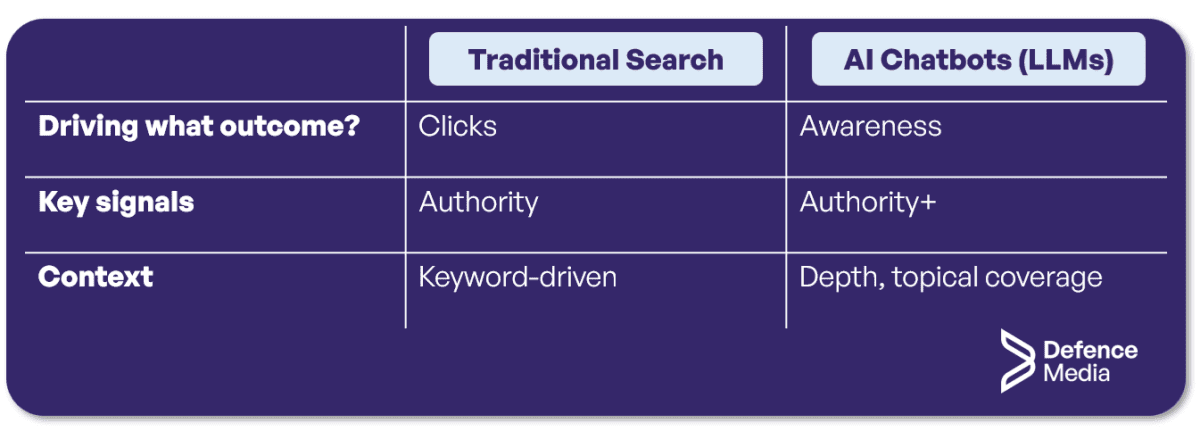
Just like traditional SEO, it’s critical that businesses and their products are seen when people are searching for information. We know that this is now evolving, but the basic premise of exposure and visibility for companies (what we would call brand awareness and associated recall) remains the same, and plays a central role in sales and growth.
AI visibility matters because it means that your business will be front and centre when people are searching for information, you become a trusted source and authority not just for AI, but also the consumers of information.
When considering AI visibility, it’s important to remember:
The good news for those companies that have endeavoured to follow good SEO practices over recent years? They will be the ones that will have an advantage in the new AEO/GEO era. As we understand more about how LLMs gather information and present it to users, we learn that many of the tactics that have aided search visibility over the years will also benefit AI visibility.
For example, many “answer engines”, including Google AI Overviews tend to favour content that ranks well in its traditional search engines, meaning that good SEO optimisation directly links into excellent AI answer optimisation.
That’s fantastic for specialist agencies like Defence Media and their clients, where we can leverage SEO best practices, as well as leverage other disciplines, including digital PR, to create an all-encompassing AI visibility strategy. LLMs take much of their information from authoritative sources, so the more your company is mentioned in trusted publications, the more likely it is that an LLM will mention you.
We recommend the following avenues when trying to build your AI visibility:
– Focus on comprehensive, high-quality content that leverages your company experts.
– Use clear structure and markup.
– Leverage AI for content, but avoid ‘AI slop’ and ensure you have an expert ‘human-in-the-loop’ for additional content and importantly editing.
– Implement schema / structured data.
– Fix technical issues and optimise UX, which is also critical for SEO and conversions.
– Ensure your content is machine-readable.
– Be referenced by authoritative sources, whether in trade media or national press.
– Do digital PR and outreach, leverage an expert agency.
– Encourage subject matter authority through interviews and article contributions.
– Track citations and brand mentions within AI-focused tools.
– Use AEO (Answer Engine Optimisation) platforms to understand what queries have AI overviews.
– Compare AI visibility against traditional SEO metrics.
| Focus Area | Suggested Actions |
| Content | Produce deep, authoritative articles; use clear hierarchy and schema |
| Technical | Schema markup; mobile/UX performance; fix errors & indexing |
| Authority | Build external mentions and citations; PR / thought leadership |
| Monitoring | Use AEO tools; track AI mentions, citations, and comparison metrics |
While many are getting excited about the rise of AI and how to outcompete other companies in LLMs, it’s worth remembering that Google and traditional search still has huge market share that won’t be going away anytime soon. Ignoring this could see your legacy SEO rankings slide, and you miss out on key conversions from those that don’t use LLMs – and that’s a sizeable number.
The most recent data showed that Google searches actually increased year-on-year, with a staggering 14 billion(!) searches per day. This is a massive 373x more searches than ChatGPT, which only sees 37.5 million “search-like” prompts a day – giving it 0.25% of market share, compared with 93.57% of Google.
As part of any AI visibility strategy, it will be important to check that your existing SEO performance is up to scratch and that you’re still ranking in traditional search engines. A combined approach that encompasses SEO, as well as AEO and GEO, will reap the most rewards for company sales and marketing teams.
Getting your business seen by AI is about evolving beyond traditional SEO. Instead of being one result among many, you want your brand to be part of the answer.
As AI-powered search becomes more embedded in how users find information, brands that optimise for visibility, authority, and structured context are the ones that will benefit most. Start with content depth, technical foundations, and earning mentions — then refine over time with measurement and iteration.


Signatories of:


Members of:


Innovation House
Molly Millars Close
Wokingham
RG41 2RX